11 Nov 2025 03:47
195. Yellow Flower Gills Me Whole - Poetry By Sid Ghosh
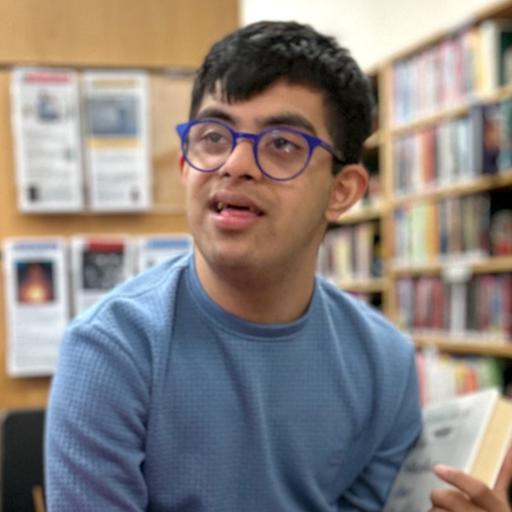
Here is another beautiful conversation we had with Dr. Vaish Sarathy and her son, poet Sid Ghosh who has published a book of poetry titled Yellow Flower Fills Me Whole. Sid has a duel diagnosis of Autism and Down syndrome and previously appeared on the podcast, with Vaish, to discuss non-linear education and how he communicates using a letter board.
Sid’s poetry book is available through Amazon or at this Milkweed link: https://milkweed.org/book/yellow-flower-gills-me-whole
Episode Transcript: https://ifweknewthen701833686.wordpress.com/2025/11/10/195-yellow-flower-gills-me-whole-poetry-by-sid-ghosh/2/
Please follow us on X @ifweknewthenPOD, you can drop us a line on our Facebook page @ifweknewthenPOD or visit our website https://www.IfWeKnewThen.com to send us an email with questions and comments. Also join our mailing list there and get alerts of future podcast episodes. Thank you again and we look forward to you joining us on the next episode of IF WE KNEW THEN.
--------
Summary:
Episode 195 of the IF WE KNEW THEN podcast features a powerful and deeply reflective conversation with poet Sid Ghosh and his mother, Dr. Vaish Sarathy. Centered around Sid’s newly released poetry collection 'Yellow Flower Gills Me Whole', our discussion explores communication, identity, disability and the transformative power of expression. Sid, an 18-year-old with Down syndrome and autism, communicates using a letterboard, spelling out his thoughts with intention and precision. We make a point to highlight how essential it is to witness this process visually, as it reveals not only how Sid communicates but also the depth and complexity of his thinking. What emerges quickly is that Sid does not experience language in conventional ways. He explains that he “thinks in poetry” because typical speech is difficult for him. This insight reframes assumptions about communication and intelligence, illustrating that expressive language can exist richly even when it looks different. We dive into Sid’s creative process, which is rooted in consistent practice rather than structured composition. His poems, written over several years, are part of a daily or weekly ritual. Titles come last, reinforcing that his work begins as pure thought and evolves organically. His poetry is abstract yet deeply intentional, filled with metaphors that challenge readers to reconsider meaning, identity, and perception. One of the most impactful part of the podcast episode centers on a poem titled “Interstices,” where Sid describes “gaps” left by neurotypical individuals. These gaps, he explains, are spaces where his life exists between societal expectations and misconceptions. Through guided interpretation, the conversation reveals a profound critique of how disability is framed, particularly by parents and society. Sid identifies two “knots”: sadness and the need for perfection. He suggests that the life of a person with a disability exists between these pressures. Between grief-driven narratives and unrealistic ideals. This perspective leads to a powerful insight: that embracing disability with pride, rather than sadness or a fixation on perfection, is liberating. Sid defines “madness” (a word he reclaims) as “letting go,” associating it with freedom and self-acceptance. His poetry challenges dominant narratives that portray disability as tragedy, instead offering a vision of identity that is whole, complex and worthy of celebration. Together, we also touch on real-world implications of these narratives. Sid shares discomfort with spaces where parental grief dominates, such as conferences, explaining how these discussions can feel limiting or harmful. We connect this to our own experiences as parents, reflecting on how societal narr