4 Nov 2025 02:03
Maps of Meaningness
Before controversy and fame, Jordan Peterson was a psychologist theorizing myth and meaning.
Jake Orthwein points out striking similarities in Peterson’s work and David’s. Along with them, fundamental disagreements: partly due to Peterson bringing a Christian perspective, and Chapman a Vajrayana Buddhist one.
Nihilistic catastrophes ※ Chaos and order ※ Reconciling myth and rationality ※ Interactionist cognitive science ※ The purpose of life
Jake intercut our conversation with brief relevant clips from Jordan Peterson’s classroom lectures and media interviews. It’s fun seeing the commonalities and contrasts!
In this post:
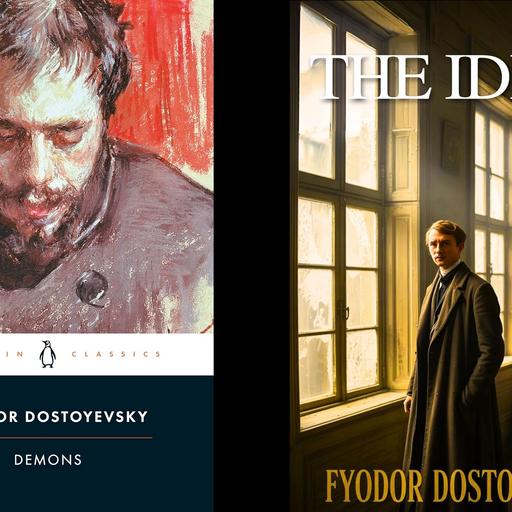
* The Making Of: demons and the idiot
* Sections and topics in the video, with timestamps so you can find them
* Further reading: books &c. we refer to, with links
* “AI”-generated “transcript” (not safe for human consumption)
Demons and the idiot
This podcast has been years in the making. Our attempts were incessantly obstructed by malicious demons, who don’t want you to see or hear it. Eventually this became comical, although also frustrating.
To be fair to the demons, progress was also frequently obstructed by an idiot. Namely: me, David. I fumbled the technology repeatedly.
After finally getting to record the conversation, I applied “AI” to remove pauses and “ums” and such. This improved the audio track, but makes the video extremely jerky. Also, I used “AI” to make it appear as though we are looking at the camera when we weren’t. An uncanny, demonic appearance results. And, because I am an idiot, I did this irreversibly. Sorry about that!
Next time, I will perform extensive exorcisms and protective rituals. And also learn how to use software before inflicting it on Jake’s invaluable contribution. Or leave the editing to him; he’s a professional!
Sections and topics
00:00:00 Introduction
00:01:05 David summarizes Meaningness (his book): it’s about the inseparability of nebulosity and pattern.
00:05:01 The intellectual lineage of Meaningness is mainly the same as that of Jordan Peterson’s Maps of Meaning. However, David draws on Vajrayana Buddhism where Peterson draws on the Western tradition, particularly Christianity.
00:07:48 Nihilism, as explained by Nietzsche and as in Buddhism, is a key topic for both of us. Psychological lineages: German Romanticism, Carl Jung, Jean Piaget, Robert Kegan, Robert Bly.
00:10:54 Jake summarizes Peterson’s project and intellectual lineage. The catastrophes of the twentieth century. Recovering the mythic mode as compatible with rationality. Envisioning positive futures and preventing nihilistic ones.
00:20:59 The history of the gradual collapse of meaning. Tradition, modernity, postmodernity: communal/choiceless, systematic/rational, and postrational/nihilistic modes.
00:32:20 A future that combines the advantages of different historical modes of culture, social organization, and psychology, avoiding their disadvantages. Subdividing the past century: totalitarianism, countercultures, subcultures, atomization. Those abandoned, in order, nobility, universality, rationality, and coherence. We can restore all of those, but not as absolutes.
00:43:32 Jake explains Peterson’s somewhat different take on the same historical periods. Rationalism and modernity as the result of encountering alien cultures.
00:53:02 Jake explains Peterson’s “universal grammar” of myth in the Western tradition: Chaos is the Great Mother, Order is the Great Father,