
12 Aug 2026 12:00
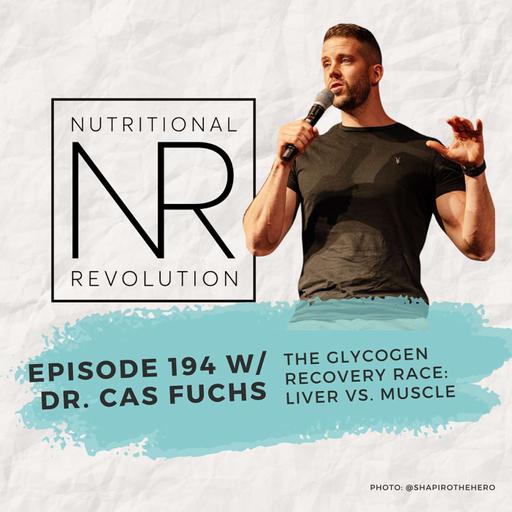
The Glycogen Recovery Race: Liver vs. Muscle
In episode #194 Dr. Cas Fuchs joins Kyla to break down a 2025 crossover study on carbohydrate intake, liver glycogen, and muscle glycogen recovery after exhaustive cycling. The episode focuses on what 10 grams per kilo of body mass actually does in a 12-hour recovery window, and why the liver refills much faster than muscle. They also cover how glycogen is measured with MRI and MRS, why sucrose was used in the recovery protocol, and what this means for stage-race fueling, carb loading, and sleep between efforts.
KEY TAKEAWAYS
- Dr. Cas Fuchs shares his background in human physiology, sports nutrition, and elite cycling research, including work in Maastricht and with Team Visma Lease a Bike.
- In this episode: why the liver is less studied than muscle, and how MRI plus MRS can estimate glycogen without relying only on biopsy.
- They discuss the 2025 crossover study in 12 well-trained male cyclists using exhaustive cycling, then 12 hours of either no carbohydrate or 10 grams per kilo of carbohydrate.
- In the no-carb condition, both liver and muscle glycogen stayed low after exercise, showing little to no recovery over 12 hours.
- In the carb-fed condition, liver glycogen was restored within 6 hours, but muscle glycogen was still not fully replenished at 12 hours.
- Cas explains why sucrose was used early in recovery: the glucose plus fructose mix is especially effective for liver glycogen repletion.
- They discuss practical fueling for stage races, including the role of immediate post-race carbs, overnight recovery, breakfast, and the importance of sleep.
- Kyla and Cas compare the study protocol to real-world elite cycling, where riders may ingest very high daily carbohydrate intakes, often spread across the bike, recovery, and meals.
- They explore how personalized carbohydrate needs may vary by body size, muscle mass, race role, and how much glycogen an athlete actually uses.
Please note that this podcast is created strictly for educational purposes and should never be used for medical diagnosis or treatment.
ABOUT DR. CAS FUCHS:
Dr. Cas Fuchs is an assistant professor in the Department of Human Biology. His research primarily focuses on skeletal muscle metabolism, with an emphasis on recovery, muscle adaptation, and atrophy.
He investigates how nutrition (carbohydrates, proteins) and interventions such as cooling and heating influence muscle recovery and adaptation. Additionally, he studies muscle atrophy resulting from aging and inactivity and evaluates strategies to preserve muscle mass and function under these conditions.
For his research, he employs advanced techniques, including stable isotope tracer methodology and Magnetic Resonance Imaging/Spectroscopy.
FREE RESOURCES:
- Free Recovery Protocol: https://mailchi.mp/nutritional-revolution.com/recovery-protocol
FOLLOW DR. FUCHS:
- LinkedIn: https://nl.linkedin.com/in/casfuchs
- Instagram: https://www.instagram.com/CASFUCHS/
- M3 Research Group: https://www.m3-research.nl/
TIMESTAMPS
00:00 - Welcome and Dr. Cas Fuchs’ research background02:38 - From Maastricht to elite sports nutrition research07:56 - Why study 10 grams per kilo after cycling10:06 - Where the body stores carb and how much muscle and liver can hold12:10 - Estimating glycogen with MRI, biopsy, and MRS14:36 - Study design: 12 well-trained male cyclists in a crossover protocol16:26 - 12-hour recovery window with no carbs versus 10 grams per kilo17:51 - Why the exercise bout was fully fasted and glycogen-depl

