
15 Sep 2026 11:30
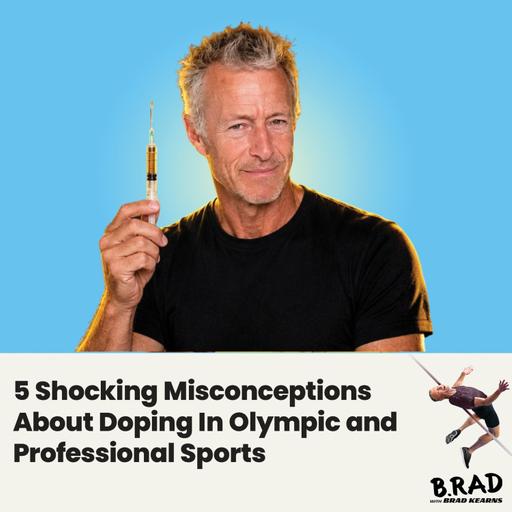
5 Shocking Misconceptions About Doping In Olympic and Professional Sports
Almost everything the average sports fan believes about doping is wrong.
The “dirty cheaters stealing medals from clean athletes” story almost never describes what actually happened. Instead, we’ve had dirty sports, Cold War dynamics, and athletes faced with the “if you can’t beat ‘em, join ‘em” devil’s bargain. In this show you’ll learn why doping has been cleaned up significantly from past eras, where the problem remains, and why professional cycling is perhaps the most glaring example.
You’ll also learn surprising insights about the physiology of doping: Steroids don’t actually magically make you bigger, stronger, or faster. Training does. Doping alters your body chemistry so you can recover faster and train harder. Doping can’t transform an ordinary person into an Olympian, which is why doping up a bunch of retreads and has-beens at the Enhanced Games resulted in pedestrian times in comparison to the world’s elite.
We’ll cover EPO, the Goldman Dilemma, the Eastern Bloc origins of Olympic doping, and crazy scandals from Lance Armstrong and BALCO to the heartbreaking case of Shelby Houlihan’s controversial four-year suspension.
We close with a discussion about the morality and philosophy of what it means to age gracefully - questions I’ve been asking myself as I strive to be the best 60+ athlete I can be. Is this more honorable than trying to dope myself into a fake 30-year-old? Or should we consider taking advantage of modern pharmaceutical advantages to be the best we can be? If so, do we push the envelope of, “has self-optimization become permission for unbridled narcissism?”
Get ready for a heavy show that will leave you never thinking the same way about doping in big time sports again, and also reflecting on the implications of anti-aging and biohacking therapies differently than you may have before!
TIMESTAMPS:
For decades, doping in Olympic and professional sports has been a huge concern, controversy, headline stories, and it has been hugely misunderstood on many levels by the average sports fan. [02:42]
Myth number one is that doping is commonplace in Olympic and professional sports. [04:57]
One of the reasons these suspicions persist is marketing hype and propaganda. [11:38]
Why do these suspicions about doping persist? [15:38]
Back in the 70s and 80s the western athletes were losing to doped up competitors. What did they tend to do? [20:48]
From that point there was much testing and continuing use of steroids, then sport got boring until baseball got into players hitting the ball out of the park. [27:28]
The BALCO scandal in the early 2000s was when some undetectable steroids that were not on the banned list were invented. [30:06]
In the 2004 Athens Olympic Games, there was an incident where two of the favored athletes did not appear for their tests right before the opening ceremonies. [35:21]
Today we have more sophisticated testing and are even able to freeze some samples to test later when more advanced testing becomes available. [39:21]
A big game changer that came in the 90s was the discovery of EPO, a natural substance secreted by bone marrow and stimulates the production of red blood cells. [41:28]
There are several countries involved in state-sponsored programs as well as small impoverished nations that are poorly regulated. [46:14]
In baseball and other sports, they have penalties that aren't very severe. [56:12]
There is another category of athletes that are perhaps ,toward the end of their careers, who might want to go out with a bang and have little to lose. [01:00:56]
There are many young athletes who develop their skills and break records, but are not necessarily suspected of doping. [01:04:55]
There are many instances where athletes have been tested for substances that

