
14 Oct 2026 10:58
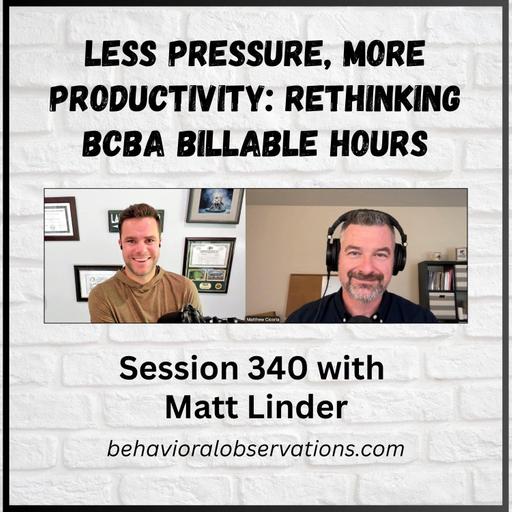
Less Pressure, More Productivity: Rethinking BCBA Billable Hours | Session 340 with Matt Linder
What happens when an organization responds to a productivity problem by lowering its billable-hour requirement?
In Session 340 the Behavioral Observations Podcast, Matt Linder, Chief Operating Officer of First Children's Services, and Founder and CEO of Desired Effect Coaching Solutions, joins me to discuss an organizational challenge that will be familiar to many ABA providers: high BCBA turnover, low morale, and a compensation system built around demanding billable-hour expectations.
Matt describes how the existing system required BCBAs to average 28 billable hours per week and included consequences for falling short of those expectations. At the same time, the organization was experiencing substantial BCBA turnover, with 31 BCBAs leaving over an 18-month period.
Rather than simply increasing pressure to meet productivity expectations, Matt helped redesign the system.
The organization lowered required billable hours by approximately four hours per week while maintaining salaries, and introduced a positive reinforcement-based bonus system that allowed BCBAs to earn additional compensation for exceeding their targets and supervising behavior technicians.
How did this all work out? Tune in to hear how making these somewhat counterintuitive changes substantially reduced turnover and increased productivity.
During our conversation, Matt and I discuss:
- Why the original compensation and productivity system was creating problems.
- How turnover costs helped make the business case for changing the system.
- The decision to lower billable-hour requirements while maintaining BCBA salaries.
- Shifting from punitive contingencies to a bonus system based on positive reinforcement.
- Creating a transparent compensation calculator so employees could see how the new system would affect their earnings.
- The importance of employee feedback and trust during organizational change.
- Monitoring for unintended consequences when changing performance contingencies.
- Why financial and productivity measures aren't sufficient without meaningful measures of clinical outcomes.
- Developing career ladders and leadership opportunities for RBTs.
- Lessons for behavior analysts who want to begin doing OBM work.
Matt also discusses several initiatives currently underway at First Children's Services, including improved measurement of clinical outcomes, an RBT career ladder and mentorship system, and the integration of newly acquired private schools.
Toward the end of the conversation, Matt offers a useful starting point for behavior analysts interested in OBM: identify clearly what you're trying to accomplish, determine how you're going to measure it, and then use behavioral principles to evaluate whether the changes you make are actually producing the outcomes you want.
Resources:- First Children's Services: firstchildrenservices.com
- Careers at First Children's Services
- Matt Linder: [email protected]

