31 May 2026 05:22
Move to Learn: How Movement Activates the Brain and Fuels Motivation (with Dr. Chuck Hillman and Paul Zientarski)
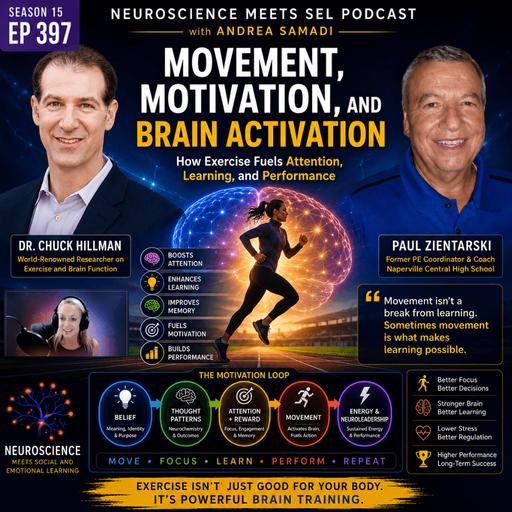
Season 15, Episode 397 revisits research and real-world practice showing movement is more than fitness: it activates the brain, boosts attention, enhances learning, and sustains motivation. Dr. Chuck Hillman’s studies reveal how even short bouts of exercise light up brain activity, while Paul Zientarski's Naperville program demonstrates how heart-rate monitoring and purposeful movement improve readiness, recovery, and academic performance. In EP 397: Movement, Motivation, and Brain Activation with Dr. Chuck Hillman and Paul Zientarski, we explore why movement may be one of the most powerful tools we have for improving brain function, learning, motivation, and performance.
In this episode, we cover:
✅ Why most children are not meeting the recommended daily physical activity guidelines and what we can do to change that.
✅ How exposing children to a variety of activities helps them discover movement they enjoy—and are more likely to continue throughout their lives.
✅ Why there is no perfect exercise program, and why the best exercise is the one you'll consistently do.
✅ How enjoyment, reward, and dopamine reinforce healthy habits and keep the Motivation Loop repeating.
✅ What Naperville Central High School learned from heart rate monitoring and how recovery impacts performance.
✅ Why peak performance requires both effort and recovery.
✅ How exercise changes the brain, improving attention, learning, memory, and cognitive performance.
✅ The groundbreaking research behind Spark: The Revolutionary New Science of Exercise and the Brain and how it changed the way educators think about learning.
✅ Why movement is not a break from learning—but one of the most effective ways to prepare the brain for learning.
✅ How movement fits into our Phase 2 Motivation Loop, helping transform motivation into action and sustaining long-term performance.
The biggest takeaway?
Movement isn't just exercise. It's activation. It's preparation. It's performance.
When we move our bodies, we activate the brain systems responsible for attention, learning, motivation, and success.
The episode highlights practical takeaways: expose children to varied enjoyable activities, prioritize consistency over intensity, use movement as cognitive preparation, and track recovery to protect motivation. Movement becomes a bridge between motivation and sustained performance—improving focus today and long-term brain health tomorrow.
Welcome back to Season 15 of the Neuroscience Meets Social and Emotional Learning Podcast.
I'm Andrea Samadi, and on this podcast, we bridge the science behind social and emotional learning, emotional intelligence, and practical neuroscience so we can create measurable improvements in well-being, achievement, productivity, and results.
Movement, Motivation, and Brain Activation with Dr. Chuck Hillman and Paul Zientarski
This week, we continue our journey through Phase 2: Neurochemistry and Motivation, where we've been exploring one central question:
What drives sustained effort and forward movement? So far, we've learned that motivation begins with belief and meaning from Bob Proctor[i], is shaped by our thought patterns with Dr. Caroline Leaf,[ii] strengthened through attention and reward with Dr. John Medina[iii], and powered by the brain's dopamine-based motivation system through Dr. Anna Lembke's[iv] work.
But today, we arrive at a fascinating question:
What happens when we actually move?
Because motivation isn't just something that happens in the mind.
The brain was designed to work in partnership with the body.
And according to our review of today's two guests, one of the most powerful ways to activate attention, learning, memory, and motivation is through movement itself.
This week we're revisiting insights from two pioneers whose work helped transform our understanding of movement and learning.
First, Dr. Chuck Hillman, one of the world's leading researchers on exercise and brain function, whose groundbreaking research has shown