
20 Oct 2026 02:08
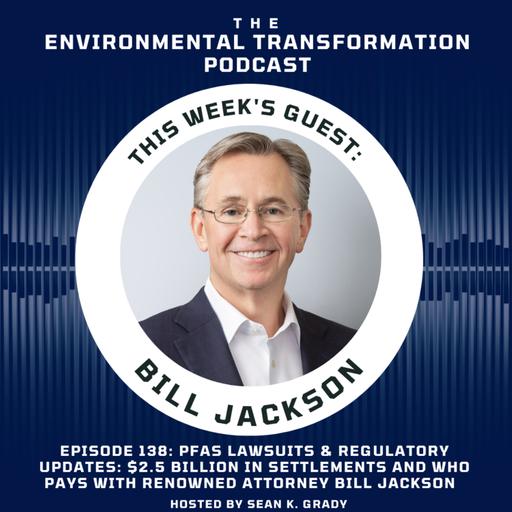
PFAS Lawsuits & Regulatory Updates: $2.5 Billion in Settlements and Who Pays with renowned attorney Bill Jackson of Kelley Drye & Warren
PFAS litigation produced New Jersey settlements with DuPont and 3M valued at $2.5 billion. Water utilities and ratepayers still face treatment costs.Environmental attorney Bill Jackson of Kelley Drye & Warren talks with Environmental Transformation podcast host Sean Grady about representing 15 states in contamination cases. He explains how natural resource damages differ from remediation costs, why states can bring claims outside CERCLA, and how public claims based on risk differ from an individual's effort to prove that exposure caused cancer.Jackson also addresses a difficult distinction: holding a chemical manufacturer responsible is not the same as pursuing the companies that used its products. He describes how the PFOA and PFOS hazardous substance designations affect property owners and firefighting foam users, and why enforcement discretion does not necessarily protect passive receivers from private lawsuits.For utilities and industrial operators, the discussion covers upstream discharge testing, internal PFAS audits, historical insurance policies and the cost of contamination in biosolids applied to farmland. Jackson explains New Jersey's approach to helping private well owners and protecting public systems from contribution claims.He closes with North Carolina's nearly $600 million settlement tied to the Fayetteville Works site and Cape Fear River contamination, describing the funding needed for water treatment and natural resource damages.Follow the Environmental Transformation podcast and sign up for the newsletter at seankgrady.com.#PFAS #WaterQuality #EnvironmentalLawCHAPTERS:0:00 Bill Jackson on PFAS Accountability4:00 Protecting Taxpayers From Cleanup Costs6:00 Why PFAS Is Not Natural Background9:00 Cleanup vs. Natural Resource Damages12:00 State Claims Beyond CERCLA15:00 Proving PFAS Risk in Court19:00 Explaining Toxicity Science to Judges22:00 Sponsor Messages25:00 CERCLA and Joint and Several Liability29:00 Chemical Makers vs. Product Users31:00 Firefighting Foam and Airport Liability33:00 Drinking Water Standards and Ratepayers36:00 Water Settlements and Private Wells39:00 Tracking Upstream PFAS Discharges43:00 Internal PFAS Audits46:00 Historical Insurance and Cleanup Costs49:00 Passive Receivers and Contribution Risk52:00 Biosolids and Contaminated Farmland56:00 Source Control at Contaminated Farms58:00 North Carolina's PFAS Settlement

