
12 Aug 2026 05:01
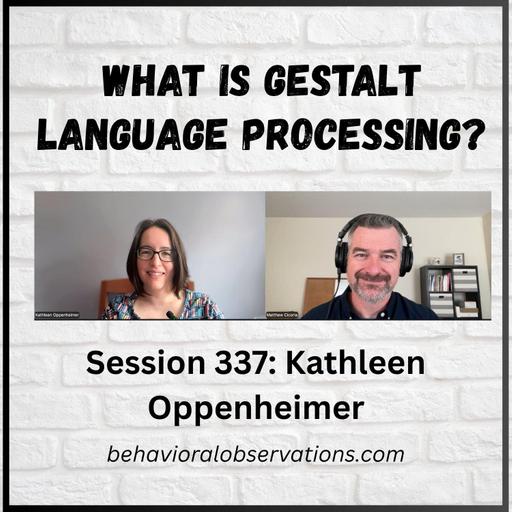
What is Gestalt Language Processing? Session 337 with Kathleen Oppenheimer
Gestalt Language Processing (GLP) and Natural Language Acquisition (NLA) have become extraordinarily popular in speech-language pathology, particularly in conversations about autistic children who use echolalia.
But what exactly is a "Gestalt Language Processor?" How would we know if someone is one? And perhaps most importantly, what does the research actually tell us about the claims and treatment recommendations associated with GLP and NLA?
In this episode, I'm joined by speech-language pathologist Kathleen Oppenheimer, who has spent considerable time examining these questions through the lens of language science and psycholinguistics.
Kathleen describes how she first encountered GLP and NLA on social media during the pandemic and why some of the claims she encountered immediately raised questions for her as someone trained in linguistics.
We unpack the distinction between language production and language processing, and discuss why observing the words and phrases a child says cannot necessarily tell us how that child is processing language.
We also explore an important nuance in this debate: Many practices commonly associated with NLA are quite reasonable—and in some cases very well aligned with established, evidence-based approaches. Following the child's lead, building strong therapeutic relationships, recognizing echolalia as meaningful communication, and honoring multiple forms of communication are all valuable practices.
But those practices aren't unique to NLA.
Kathleen contrasts NLA recommendations with research-supported approaches such as Enhanced Milieu Teaching, and explains why recommendations involving prompting, single-word models, verbs, and grammatical language input matter for language development.
Along the way, we discuss:- What GLP and NLA actually claim about language development.
- Why defining and reliably identifying a "Gestalt Language Processor" is more difficult than social media might suggest.
- The difference between what a child says and how researchers determine what a child is actually processing.
- What psycholinguistic methods such as the visual world paradigm can tell us about real-time language comprehension.
- Why echolalia can be meaningful communication without accepting the larger GLP/NLA framework.
- The substantial areas of common ground between NLA proponents and research-aligned language interventions.
- Why following a child's lead and honoring their communication does not require adopting NLA stages.
- How Enhanced Milieu Teaching differs from NLA-based intervention.
- Concerns about recommendations to avoid or delay modeling single words, verbs, and certain grammatical forms.
- What we know—and don't know—about the empirical evidence supporting GLP/NLA.
- How social media can turn nuanced clinical ideas into much broader claims.
- The potential costs of implementing unsupported interventions, even when those interventions appear benign.
- How clinicians can have productive conversations with colleagues and families who have embraced GLP/NLA.
- Why clear, jargon-free explanations of what we're doing in therapy—and why we're doing it—matter.
One thing I especially appreciated about this conversation is that Kathleen doesn't approach this as a simple choice between being "for" or "against" GLP/NLA.

