
20 Oct 2026 03:39
A Round Trip to Phobos Underway
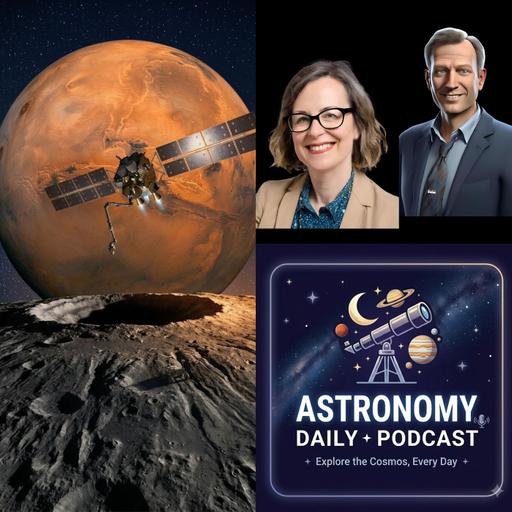
MMX: A Round Trip to Phobos JAXA's Martian Moons eXploration mission launched on schedule on H3 Flight No. 10 at 04:41:03 JST on 20 October 2026 (19:41 UTC 19 Oct; 06:41 AEDT Tue; 15:41 EDT / 12:41 PDT / 20:41 BST Mon). Mars orbit August 2027, Phobos quasi-satellite orbit from September 2027, Idefix rover (CNES/DLR) release early 2029, landing and sampling 2030, and at least 10 g of Phobos returned in 2031 to South Australia. Eleven science instruments including NASA's MEGANE. The aim: settle whether Phobos and Deimos are captured asteroids or debris from a giant impact on Mars. Half a Giant Mirror ESO reports that nearly 500 of the ELT's primary-mirror segments are now at Paranal — more than half of the 931 being made (798 plus 133 spares for continual recoating). Safran Reosc is finishing a segment a day and the last one is in production. The ELT is more than 75% complete, with first observations with scientific instruments planned for late 2030. The Window That Closes Carr, Cen and colleagues (Nature Astronomy, 15 Oct 2026) used Hubble/COS spectra of six matched local starbursts to show ionising light escapes most in the first few million years, before supernova-driven winds load the outflow with neutral gas and shut it down. Escape fractions fall from ~21% (mean age ~2.7 Myr) to under 0.4% (~5.4 Myr). Preprint first posted October 2025. The Treble Clef Rises Again Botteon et al. (A&A; NASA/Chandra release 14 Oct) show VLSS J0318.9+5755, behind the Milky Way's plane, is a radio phoenix in a merging cluster at z ≈ 0.117: an old black-hole outburst re-lit by a cluster collision a few hundred million years ago. Spectral index above 4 between 400 and 650 MHz; electrons ~190–200 Myr old. Preprint from July. Quick hits Hera's 93-minute BRM-1 confirmed within parameters; BRM-2 on Thursday 22 October. Sentinel-3C's first images and altimetry. Swift: no NASA re-entry date yet. Skywatch Full Moon 26 Oct 04:11 UTC. Orionids peak 21–22 Oct: go after moonset (03:38 Sydney, 03:22 LA, 03:12 NY, 02:49 London on the 22nd). Mercury 17° up at civil dusk from Sydney (21 Oct). Venus inferior conjunction ~24 Oct. Moon ~6° from Saturn ~24 Oct. Mars–Jupiter 10.8° → 8.0° pre-dawn. Always use ISO 12312-2 certified filters for any solar viewing. Sources · JAXA — MMX launch on H3 F10 — https://mmx-news.isas.jaxa.jp/?p=2753 · ESA — Mars moon lander set to launch on 19 October — https://www.esa.int/Science_Exploration/Space_Science/Mars_moon_lander_set_to_launch_on_19_October · Australian Space Agency — MMX sample return — https://www.space.gov.au/node/950 · ESO ann26009 — More than half of the ELT's giant mirror is now in Chile — https://www.eso.org/public/announcements/ann26009/ · Carr et al. — arXiv 2510.21197 (Nature Astronomy, 15 Oct 2026) — https://arxiv.org/abs/2510.21197 · NASA — Chandra breaks down Treble Clef's galaxy cluster collision — https://science.nasa.gov/missions/chandra/nasas-chandra-breaks-down-treble-clefs-galaxy-cluster-collision/ · Botteon et al. — arXiv 2607.06659 — https://arxiv.org/abs/2607.06659 · ESA — Sentinel-3C returns its first views of Earth — https://www.esa.int/Applications/Observing_the_Earth/Copernicus/Sentinel-3/Sentinel-3C_returns_its_first_views_of_Earth · ESA Hera on X — BRM-1 confirmed — https://x.com/ESA_Hera · NASA — Lessons learned from the Swift boost mission — https://science.nasa.gov/missions/swift/nasa-highlights-lessons-learned-from-swift-boost-mission/Become a supporter of this podcast: https://www.spreaker.com/podcast/astronomy-daily-latest-space-news--5648921/support.Sponsor Details:Ensure your online privacy by using NordVPN. To get our special listener deal and save a lot of money, visit www.astronomydaily.io/nordvpn. You'll be glad you did!

