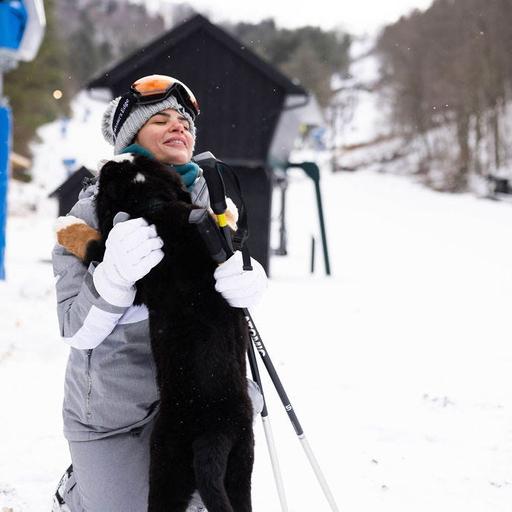
20 Nov 2025 02:57
Podcast #218: Hatley Pointe, North Carolina Owner Deb Hatley
Who
Deb Hatley, Owner of Hatley Pointe, North Carolina
Recorded on
July 30, 2025
About Hatley Pointe
Click here for a mountain stats overview
Owned by: Deb and David Hatley since 2023 - purchased from Orville English, who had owned and operated the resort since 1992
Located in: Mars Hill, North Carolina
Year founded: 1969 (as Wolf Laurel or Wolf Ridge; both names used over the decades)
Pass affiliations: Indy Pass, Indy+ Pass – 2 days, no blackouts
Closest neighboring ski areas: Cataloochee (1:25), Sugar Mountain (1:26)
Base elevation: 4,000 feet
Summit elevation: 4,700 feet
Vertical drop: 700 feet
Skiable acres: 54
Average annual snowfall: 65 inches
Trail count: 21 (4 beginner, 11 intermediate, 6 advanced)
Lift count: 4 active (1 fixed-grip quad, 1 ropetow, 2 carpets); 2 inactive, both on the upper mountain (1 fixed-grip quad, 1 double)
Why I interviewed her
Our world has not one map, but many. Nature drew its own with waterways and mountain ranges and ecosystems and tectonic plates. We drew our maps on top of these, to track our roads and borders and political districts and pipelines and railroad tracks.
Our maps are functional, simplistic. They insist on fictions. Like the 1,260-mile-long imaginary straight line that supposedly splices the United States from Canada between Washington State and Minnesota. This frontier is real so long as we say so, but if humanity disappeared tomorrow, so would that line.
Nature’s maps are more resilient. This is where water flows because this is where water flows. If we all go away, the water keeps flowing. This flow, in turn, impacts the shape and function of the entire world.
One of nature’s most interesting maps is its mountain map. For most of human existence, mountains mattered much more to us than they do now. Meaning: we had to respect these giant rocks because they stood convincingly in our way. It took European settlers centuries to navigate en masse over the Appalachians, which is not even a severe mountain range, by global mountain-range standards. But paved roads and tunnels and gas stations every five miles have muted these mountains’ drama. You can now drive from the Atlantic Ocean to the Midwest in half a day.
So spoiled by infrastructure, we easily forget how dramatically mountains command huge parts of our world. In America, we know this about our country: the North is cold and the South is warm. And we define these regions using battle maps from a 19th Century war that neatly bisected the nation. Another imaginary line. We travel south for beaches and north to ski and it is like this everywhere, a gentle progression, a continent-length slide that warms as you descend from Alaska to Panama.
But mountains disrupt this logic. Because where the land goes up, the air grows cooler. And there are mountains all over. And so we have skiing not just in expected places such as Vermont and Maine and Michigan and Washington, but in completely irrational ones like Arizona and New Mexico and Southern California. And North Carolina.
North Carolina. That’s the one that surprised me. When I started skiing, I mean. Riding hokey-poke chairlifts up 1990s Midwest hills that wouldn’t qualify as rideable surf breaks, I peered out at the world to figure out where else people skied and what that skiing was like. And I was astonished by how many places had organized skiing with cut trails and chairlifts and lift tickets, and by how many of them were way down the Michigan-to-Florida slide-line in places where I thought that winter never came: West Virgini