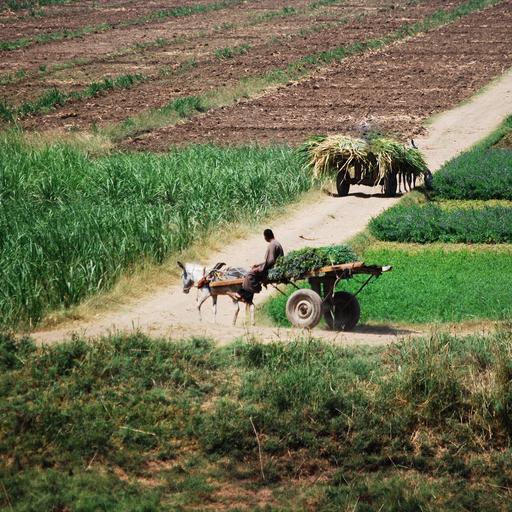
8 Jul 2026 08:00
S7 Ep34: Why farmers struggle to adopt new agricultural technology
How many maize seeds should farmers plant in each hole? Ask the farmers and they say two or three. Agronomists can show them more reliable seeds, where they only need one.
But change the seed and everything else changes too; the fertiliser, the spacing, the whole system. This is why getting better technology into the hands of African farmers, and helping them to find ways to improve their profits, is so much harder than it looks.
Rachid Laajaj (Universidad de los Andes) and Karen Macours (Paris School of Economics) tell Tim Phillips about an experiment in Kenya in which farmers ran trial plots on their own land for three seasons, comparing input combinations side by side, and were followed for five seasons more.
Farmers adopted the new inputs and their profits fell. But they kept experimenting anyway, season after season, until the losses became gains. The most skilled farmers went first, made the most mistakes, and paid the highest price; their neighbours watched, copied, and adopted at a fraction of the cost.
Each failed attempt costs a farmer a season. Lower that cost, Laajaj and Macours argue, and you change what is possible for millions of farming households.
The research behind this episode:
Laajaj, Rachid, and Karen Macours. 2026. "The Complexity of Multidimensional Learning in Agriculture." Econometrica 94 (2): 465-503.
To cite this episode:
Phillips, Tim, Rachid Laajaj, and Karen Macours. 2026. "Why farmers struggle to adopt new agricultural technology" VoxDev Talks (podcast). About the guestsRachid Laajaj is Associate Professor of Economics at Universidad de los Andes in Bogota, with research spanning technology adoption in agriculture, corruption, and human capital, studied from a micro-development perspective with particular attention to the role of information. He received his PhD in Agricultural and Applied Economics from the University of Wisconsin-Madison.
Karen Macours is a professor at the Paris School of Economics, a senior researcher at INRAE, and a Research Fellow of the Centre for Economic Policy Research in the Development Economics programme. Her research spans agricultural productivity, rural poverty, social programmes, and early childhood development. She chairs the Standing Panel on Impact Assessment of the CGIAR and is co-editor of the Journal of Development Economics.
Research and concepts cited in this episodeThe trials. In 48 randomly selected villages in Kenya, ten farmers per village were invited to run a three-season agronomic trial on a small parcel of their own land, guided by an agronomist. Each trial plot was divided into six subplots; five tested different combinations of modern inputs and one served as a control. The trials occupied a tiny share of each farm, so the direct economic effect was negligible; the point was the opportunity to learn. A further 48 villages served as controls, giving a sample of 960 farmers followed across six seasons of data collection.
Integrated Soil Fertility Management (ISFM). The input combinations tested in the trials followed ISFM principles; a sustainable intensification approach that combines improved seed with mineral fertiliser and organic inputs, adapted to local conditions. Its logic is precisely the multidimensionality the paper studies; the components work through their combination, not in isolation.
The International Institute of Tropical Agriculture (IITA) provided the agronomists who guided farmers through the trials. The paper builds on joint work with IITA.
The target-input model. The workhorse theory of learning in agriculture, in which farmers learn the optimal quantity of a single input through experience; it date