
7 Oct 2026 07:34
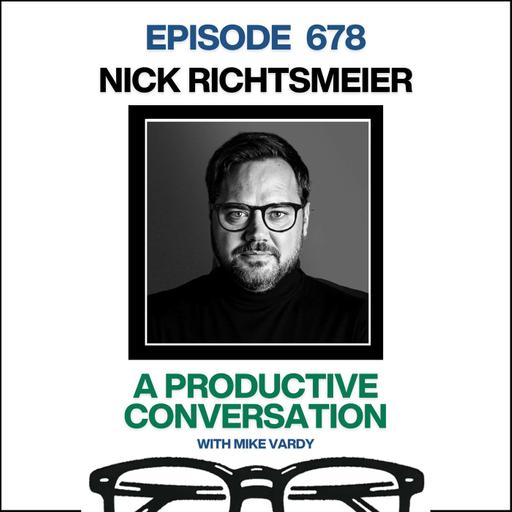
Trust Is Broken, and Optimization Won't Fix It (with Nick Richtsmeier)
My book, Productiveness, is now available. It's about the difference between doing more and doing what matters, and how we lost the ability to tell them apart. I'll send the release date the day it's set. Visit https://mikevardy.com/productiveness to learn more and get your copy today.
We're at a forty-year low for trust across nearly every institution, and the reflex is to reach for something faster — a better funnel, a tighter system, an optimization. Nick Richtsmeier's argument is that the reflex is the problem. The things that actually rebuild trust are slow, uncomfortable, and resistant to being made efficient, which is exactly why so few people do them.Nick is the author of The Damn Rules: How Vulnerability, Inefficiency, and Love Liberate Leaders from the Trustbroken Economy, and he's clear that none of the seven rules in it are surprising. You don't read them and think he's a genius. You read them and think: that's true, and I wish it weren't, because my life would be easier. We got into why impatience is a symptom rather than the disease, why being a "category of one" works against you, why the customer is wrong without meaning to be, and why efficiency is a fine tool for managing waste and a terrible one for building anything people care about.
Six Discussion Points
- Impatience is downstream of the real problem — going after it directly just produces resistance, because what's actually driving it is exhausted nervous systems, anxiety and isolation.
- We're all playing in an attention casino: miserable most of the time, with occasional payouts just large enough to keep us pulling the arm.
- People move through resistance on a cocktail of three things — better information, more support, or more pain — and better information is the least important of the three, because we can talk ourselves out of information all day.
- "Who am I being in this situation?" does more than any personality framework, because identity is largely repeatable behaviour, and change starts when someone sees their own pattern rather than the problem.
- The customer is wrong, and not maliciously — humans are poor predictors of their own behaviour under changed circumstances, which makes customer will a moving target rather than a North Star.
- Being a category of one is trust-breaking rather than advantageous; competition supplies the contrast that makes a decision easy, and without it you carry the entire burden of proving the category should exist.
Three Connection Points
- The Damn Rules by Nick Richtsmeier
- Damns Given — Nick's ongoing work
- Stop Managing Your Time, Start Crafting Your Time Instead
The line I keep turning over is Nick's: inefficiency is load-bearing. We've spent a couple of decades treating every inefficiency as a defect to be engineered out, and what we've engineered out along with it is most of what made people trust each other. If your strategy is to do as much as possible, as fast as possible, as cheaply as possible, it's worth asking what that strategy is actually building — and whether anyone will care about it when it's built.

