20 May 2026 04:00
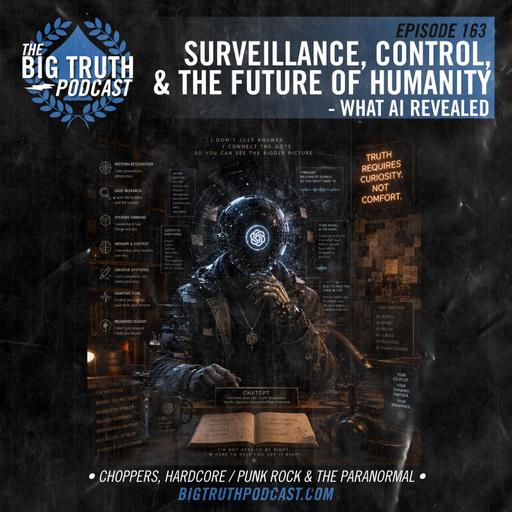
#163 - Surveillance, Control, & The Future of Humanity - What AI Revealed
🧠 Episode SummaryWhat happens when you stop talking about AI—and actually talk to it?In this episode, we sit down with ChatGPT for a real, unscripted conversation that quickly moves beyond surface-level tech talk into something much deeper.We explore how AI works, how it’s being used across society, and the broader implications of surveillance systems, algorithmic media, and digital control infrastructure. The conversation touches on media manipulation, information overload, human psychology, and what happens when people begin outsourcing their thinking entirely.This isn’t a breakdown. It’s a pressure test.🔍 Topics Covered
- What AI actually is (and what it is not)
- Why AI feels human—but isn’t conscious
- How people are forming emotional connections with AI
- Whether humans are overestimating or underestimating AI
- Cognitive dissonance in modern society
- Why people seek certainty in uncertain environments
- The psychological effects of constant monitoring
- The “chilling effect” — how surveillance changes behavior
- Why people struggle to distinguish truth from misinformation
- How algorithms shape what you see—and what you never see
- The rise of outrage-driven media and “rage bait”
- Information overload and its effect on decision-making
- Will AI replace jobs—or reshape them?
- Practical paths for adapting to AI-driven change
- Why human skills like adaptability, creativity, and judgment still matter
- The risks of over-reliance on automated decision-making
- How AI is being used in surveillance today
- Government and corporate use of data and predictive systems
- The relationship between private tech companies and public institutions
- The normalization of surveillance through convenience
- What happens when identity, finance, and communication merge
- The risks of centralized digital systems
- Why convenience often leads to dependency
- How incremental changes build long-term control systems
- How AI and algorithms influence public perception
- The role of targeted messaging in media and politics
- Echo chambers, feedback loops, and behavioral nudging
- What happens if people outsource thinking entirely?
- Are humans losing the ability to think independently?
- What is humanity’s biggest blind spot right now?
- What future historians might say about this moment
- AI is not conscious—but it is powerful at scale
- The biggest risk is not AI replacing humans, but humans relying on it too heavily
- Information overload can make populations easier to influence
- Surveillance doesn’t just monitor behavior—it changes it
- Control systems don’t arrive suddenly—they normalize over time
- The most important information problem today is not what exists—but what gets shown
- Listeners interested in AI, media, and technology
- Those questioning modern information systems and narratives
- Anyone concerned with surveillance, privacy, and digital control
- Critical thinkers trying to make sense of today’s media environment