
21 Sep 2026 06:51
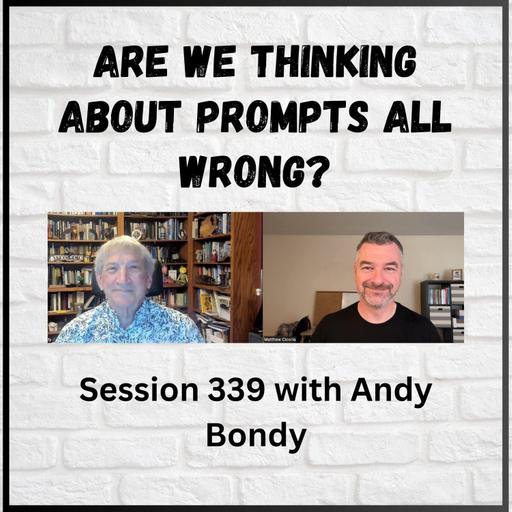
Are we thinking about prompts all wrong? Session 339 with Andy Bondy
What exactly do we mean when we say we're "fading" a prompt? Is a physical prompt inherently more intrusive—or more difficult to eliminate—than a gestural or verbal prompt? And what does "errorless learning" actually tell us about the teaching procedures we're using?
Dr. Andy Bondy returns to the podcast to tackle these questions through the lens of gradualism: the idea that meaningful behavioral change often emerges through small changes that accumulate over time.
Andy has recently been presenting on gradualism to behavior analysts and other professionals, and in this conversation we explore what the concept might contribute to the way we think about teaching, prompting, generalization, and skill development.
We begin by discussing gradualism across fields such as biology, geology, and psychology before turning to its implications for behavior analysis. Andy contrasts the traditional tendency to examine discrete behavioral units with an approach that considers the flow of behavior across longer periods of time.
From there, we take a closer look at prompts. Andy distinguishes prompts from cues and argues that prompts should be defined functionally—by whether they actually improve performance—rather than simply by their form.
We also examine some familiar language surrounding prompt hierarchies. In particular, Andy questions terms such as "intrusiveness" and "restrictiveness" when those properties aren't tied to directly measurable dimensions. If we're fading a prompt, he argues, we should be able to say what we're actually changing: distance, force, volume, time, or another measurable property.
This leads to a larger question: Is there evidence that particular types of prompts are universally easier or harder to fade?
We discuss the implications of that question for commonly used least-to-most and most-to-least prompting systems, as well as what it might look like to assess prompt effectiveness at the level of the individual learner and skill rather than relying exclusively on predetermined hierarchies.
Later in the conversation, we broaden the discussion to generalization and fluency. Andy argues that programming for generalization shouldn't begin only after a skill reaches mastery and that behavior analysts should attend not only to stimulus generalization, but also to important dimensions of the response itself—including rate, duration, speed, and fluency.
Finally, we discuss "errorless learning." Andy questions whether the term provides enough information about what an instructor is actually doing and suggests that minimizing errors—while naming the specific procedures being used, such as fading or time delay—may be a more useful way to describe our teaching.
Topics discussed include:- What gradualism means in behavior analysis
- Prompts versus cues
- What makes a prompt a prompt
- Prompt fading versus changing prompt types
- Problems with terms such as "intrusiveness" and "restrictiveness"
- Whether prompt hierarchies should be individualized
- Assessing prompt effectiveness
- Stimulus and response generalization
- Accuracy versus fluency
- Programming for rate and speed
- Why generalization should be considered from the beginning of instruction
- "Errorless learning" versus minimizing errors
- The importance of describing teaching procedures in measurable, observable terms
This conversation offers a useful challenge to several piec

