
26 Sep 2025 06:40
Colloque - Katia Coutant, Alban Guyomarc'h & Yann Robert : General Discussion, introduced and chaired by Young Researchers
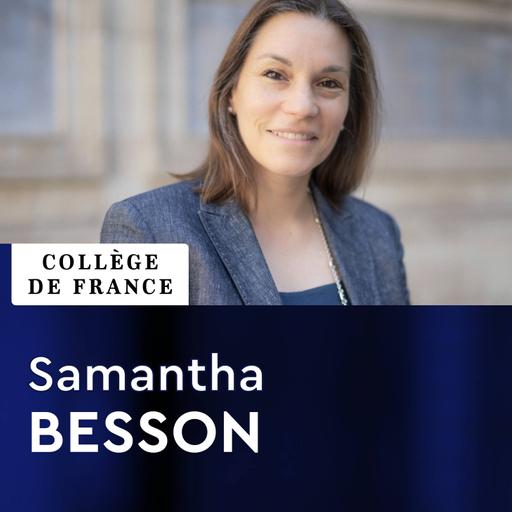
Samantha Besson
Droit international des institutions
Collège de France
Année 2025-2026
The "Province of All Mankind"? Property in Outer Space under Public and Private International Law & Philosophy
Colloque - Katia Coutant, Alban Guyomarc'h & Yann Robert : General Discussion, introduced and chaired by Young Researchers
Panel 4: General Conclusions and Discussion
Colloque organisé par la Pr Samantha Besson, chaire Droit international des institutions, les 25 et 26 septembre 2025
Présentation
As it is the case in other (marine or polar) "spaces" of international law usually defined negatively as areas beyond the (territorial) jurisdiction of States, a "non-appropriation" principle applies to the outer space (art. II 1967 Outer Space Treaty; art. 11(2-3) 1979 Moon Agreement). Despite later clarifications in the 1979 Moon Agreement, States still disagree, however, about both the material scope of the principle of non-appropriation (celestial bodies only, or both the bodies and their extracted resources) and its personal scope (public appropriation in the form of sovereign claims by States only, or both public and private appropriation). They also disagree about the implications of the second, more positive principle that was added in the Moon Agreement, i.e. that of "common heritage of mankind" (art. 11(1) Moon Agreement) and about the content of the further principle of "equitable access and sharing of benefits" (art. 11(7d) Moon Agreement) that applies to the common exploitation of celestial resources. In any case, due to the limited number of State ratifications (17 to date), the Moon Agreement is not considered as an expression of universally binding customary law. The same applies to the international regime for the common exploitation of the natural resources of celestial bodies foreseen by the agreement (art. 11(5-7) and 18 Moon Agreement).
This disagreement is sharpened by the tension between those more recent principles, including non-appropriation through use, and the original principles of the international law of "areas beyond national jurisdiction", i.e. the principle of "freedom of exploration and use" (art. I(1) Outer Space Treaty) and its twin principle, i.e. the "freedom of scientific investigation" (art. I(3) Outer Space Treaty; art. 6(1) Moon Agreement). Those original principles have been left untouched by the new ones, indeed, and seem to accommodate free appropriation of resources through use, even if those freedoms have to be "carried out for the benefit and in the interests of all countries" (art. I(1) Outer Space Treaty; art. 4(1) Moon Agreement). The same tensions between the original principles and the subsequent ones also apply within other spaces of international law such as the high seas and deep seabed and have not been resolved by the 2023 Agreement on the Conservation and Sustainable Use of Marine Biological Diversity of Areas beyond National Jurisdiction.
This indeterminacy has led certain States and regional organizations to adopt domestic (public and private) legislation, develop soft law and/or conclude bilateral agreements to secure the property rights and investments of private companies authorized by those States to explore and exploit celestial bodies and their resources. Their hope thereby is to shape what is called, in international treaty law, a "subsequent practice in the application of treaties establishing an agreement". If those States were to succeed, that practice could influence the interpretation of the Outer Space Treaty. After all, this is exactly what some States did in 1982 after the adoption of the Convention of the Law on the Sea and following their disagreements about the organization of the international regime for the common exploitation of the deep seabed resources in the convention. So-doing, they steered that regime towards the 1994 compromise and the modification of the convention that ensued and, arguably, led to that regime's co

