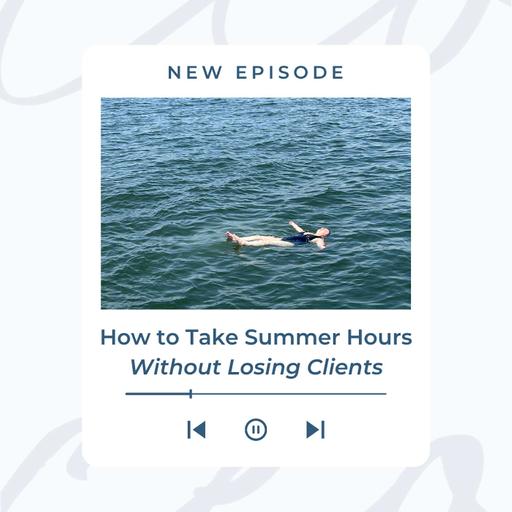
How to Take Summer Hours Without Losing Clients
I grew up in the river realm of Virginia, where everyone either had a boat or knew someone who did, and summer meant Friday afternoons out on the water before the weekend even started. The reason my family got to do that was simple. My dad ran summer hours in his business, and by noon on Friday the office was empty and everyone was gone.
I didn’t clock it as a business decision back then. I just knew we were a little different. But I’ve run summer hours in my own business every single year since, and every time I bring the idea to another business owner, I hear the same fear underneath it. If I’m less available, I’ll lose clients.
You won’t. Summer hours are not an availability problem. They’re a communication problem, and that’s something you can fix in an afternoon.
This episode is your permission slip, except the permission isn’t coming from me. It’s coming from you. I’ll walk you through how I set my hours, the way I communicate them so nobody panics, and how my model calendar turns the boundaries living in my head into something my team and my family can see and plan around.
Decide your hours. Communicate them everywhere your clients reach you, well before the season starts. That’s the whole move, and by the end of this one you’ll know how to make it.
What You’ll Learn in This Episode
- Why setting summer hours is a communication problem and not an availability problem, and how that one distinction changes everything about how you handle it
- The exact way my parents announced summer hours every year with no apology and no long explanation
- How to reset client expectations around your response time without losing a single client
- What a summer autoresponder should actually say so it does the heavy lifting before you ever open your inbox
- The difference between summer hours and a true out of office, and how to communicate a longer stretch away
- How a model calendar turns the boundaries in your head into something your family and your team can plan around
- The one standing appointment that stays on your calendar no matter what season you’re in
Key Concepts from the Episode
It’s a Communication Problem, Not an Availability Problem. The fear is that shorter hours will cost you clients. What actually rattles clients is not knowing what to expect, and expectations are something you get to set. Clients don’t bristle at shorter hours. They bristle at not knowing what to expect.
State It Plainly, Skip the Apology. My parents announced summer hours everywhere a client might look, on the website, in email footers, on the voicemail, on a sign at the door, with no apology and no justification. Just the new normal, posted before the season started. You’re not asking permission to take Fridays. You’re telling people how summer works.
The Autoresponder Does the Work. A summer autoresponder sets your response time the second someone emails you, and a short FAQ of your most common requests answers half of them before they reach you. Set the expectation the moment someone hits send, and you stop answering the same question all summer.
The Model Calendar Makes Boundaries Visible. My model calendar maps my ideal week into theme days, CEO day, client day, content day, and CEO Collective day, so nothing gets dropped and my capacity is obvious at a glance. It also lets my family and my team plan around me instead of guessing. A boundary that only lives in your head is one nobody else can honor.
The CEO Date Is the Non-Negotiable. Whatever shifts for the season, the weekly CEO date stays. It’s the standing block where you work on the business, check your 90-day plan, and track your 12-month goals. Summer hours change with the season. The CEO date is the appointment that doesn’t.